
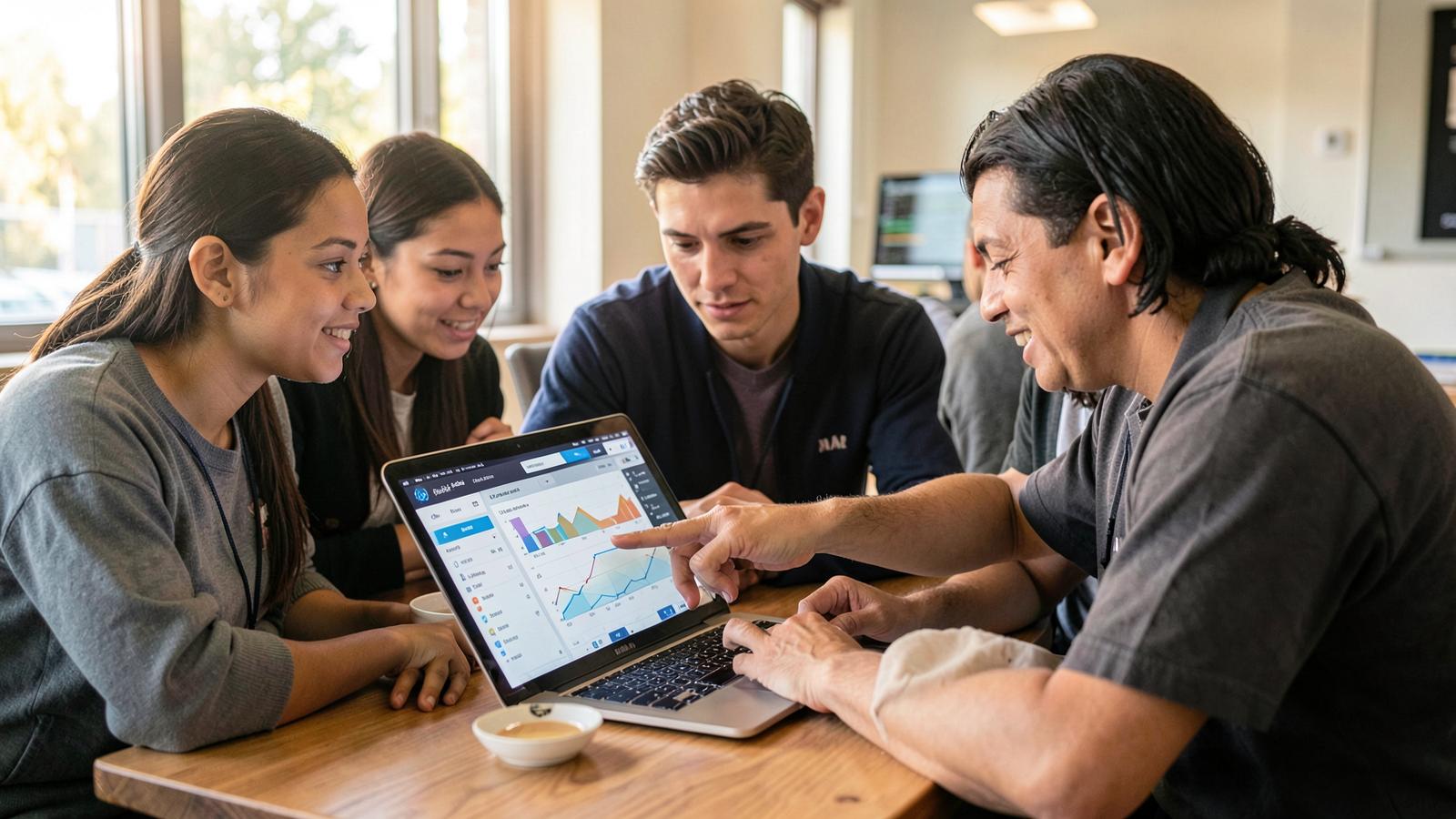
"Mentor-led" is on a lot of course pages. It rarely means the same thing twice. At Magnimind it means a working data scientist looks at your work every week and tells you the truth about it. This is what that hour looks like.
Before the session: you ship something
Sessions are built around your project, not a lecture. By the night before, you push your notebook or pull request and post three lines in the channel: what you did, where you are stuck, and what you want feedback on. Mentors read it before the call. If nothing is pushed, the session becomes a planning conversation — useful once, embarrassing twice.
Minutes 0–15: code and analysis review
The mentor opens your work on screen. Typical comments from a recent session on a churn model:
- "You fit the scaler on the full dataset before the split. That is leakage — your 0.91 AUC is not real."
- "This groupby is doing three things. Name each step; future-you will thank you."
- "Your chart says accuracy went up. What does the business actually lose on a false negative?"
This is the part you cannot get from a video. Someone with judgment is looking at your decisions.

Minutes 15–35: direction
Next comes the question of what to do next week. Mentors push toward the smallest thing that produces a real result: a baseline before a neural network, a clean pipeline before a fancy feature, a written summary before a deck. Most learners over-scope; mentors under-scope on purpose so you finish.
Minutes 35–50: interview drill
Every session ends with one interview-style question tied to what you just did. "Explain precision and recall to a product manager." "Walk me through how you would validate this model over time." You answer out loud; the mentor gives you the version a hiring manager wants to hear. By the end of the program you have done this thirty or forty times.
What mentors expect from you
- Show up with something shipped, even if it is broken.
- Ask specific questions. "Is this right?" gets a worse answer than "I chose a random split over a time split — what would you do?"
- Write down the feedback and act on it before the next session. Mentors notice.
- Take the interview drill seriously. It feels awkward for three weeks and then it doesn't.
Why it works
Feedback loops are the whole story. A self-paced course gives you one loop: did the quiz pass. A mentor gives you dozens of loops per week on the things that actually matter in the job — judgment, communication, scope. That is the difference between knowing pandas and being hireable.
If this sounds like the kind of week you want, read about the Mentor-Led Data Science & AI Internship or start an application. Not ready for a mentor yet? The free academy is where most of our interns started.